

A card on a silver tray
In 1890, a servant carried a tray of calling cards into a Fifth Avenue drawing room. On one of them were two words that carried unusual weight in New York society: Mrs. Astor.
For decades that title belonged to Caroline Schermerhorn Astor, who decided who existed in New York society and who did not. The new card belonged to the wife of her nephew, William Waldorf Astor. Two women, one crown.
Caroline objected. The newspapers discovered the quarrel and did what newspapers have always done when extremely rich people behave badly: print the gossip and magnify the rivalry. New York society eventually knew Caroline as "The Mrs. Astor".
William had gone to war over a definite article and handed his aunt one.
The war of the storeys
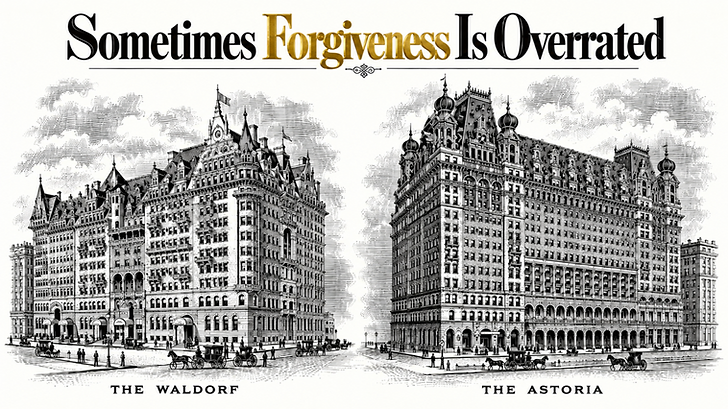
William owned the red brick house beside his aunt's, at Fifth Avenue and 33rd Street. He demolished it and built a 13 storey hotel in its place.
The Waldorf Hotel opened in 1893 and became an immediate sensation. Designed by Henry Hardenbergh in the German Renaissance style, it drew society figures, celebrities, and wealthy New Yorkers to its 450 guest rooms and grand public spaces, including the Palm Garden courtyard and the Empire Room restaurant.
Caroline complained bitterly about the commercial establishment next door, living quite literally in its shadow.
Then her son, John Jacob Astor IV, answered by demolishing his mother's mansion and building an even more lavish 16 storey Hotel Astoria beside the Waldorf.
Article content
The new Waldorf next to Caroline's manssion
The deal
The two branches did not suddenly become one happy family.
Representatives worked out the arrangement that joined their hotels. Abner Bartlett represented William's side, while George F. Peabody represented the other branch. The arrangement came through intermediaries rather than a family reunion.
George Boldt, who ran the Waldorf, had also prepared for a possible connection. Because 33rd Street and 34th Street sat at different elevations, the Waldorf's main floor had been positioned so that an adjoining development could meet it at the appropriate level.
They created the possibility of connection before any agreement to connect.
And then came the detail that made me rethink forgiveness.
The price of the doorway
The Astoria remained a separate structure.
They made openings between the buildings so the two hotels could operate together, and the arrangement protected the Astoria's independence. Boldt had to provide a bond to fund closing those openings again with brick and stone. That brick clause was the condition of the agreement rather than a footnote to it. Caroline's estate held tightly to its rights, and the openings were permitted only because closing them again was guaranteed and paid for in advance. No bricks, no doorway.
Think about that. They financed the openings, and they financed the bricks that could close them. The exit clause is what made the entrance possible. Political scientists arrived at this in 2001, finding that agreements which contain a priced escape clause are easier to reach and hold together longer than agreements without one. Boldt paid for the bricks in 1895.
On 1 November 1897, the Astoria opened and the two hotels operated together as the Waldorf-Astoria. Inside, Peacock Alley became one of New York's great social promenades, where people came to see and, more importantly, to be seen.
The feud had produced something neither branch could have created alone. Forgiveness was never a prerequisite in the contract.
Article content
Peacock Alley 1903 The original Waldorf-Astoria Hotel
Belfast
More than a century later, Belfast gives us a larger and far more painful example of practical peace.
The Good Friday Agreement did not make generations of fear, grief and division disappear. A 2023 Queen's University Belfast account counted 30.5 kilometres of walls across 97 barriers and other forms of defensive architecture, more than stood there in 1998. Northern Ireland's Department of Justice still publishes opening hours for several interface gates. Flax Street, for example, opens daily from 06:30 to 22:00. The wall remains while the gate opens.
The weapons went too, and the sequence matters. Decommissioning was built into the peace process and continued for years after the 1998 agreement under independent verification. In September 2005, the IICD reported that the Provisional IRA had put all arms under its control beyond use. Loyalist decommissioning continued later, with major events extending into 2010.
Peace cannot be built while civilians are still being bombed, and no culture survives treating terror as a negotiating position. Belfast priced the relapse. An independent commission reported on who was still armed, and the law attached a cost: ministers could be excluded, Assembly salaries cut, party funding reduced, and after the commission's 2004 report, one party's members lost their salaries.
The Astors funded the bricks that could close the doorway. Belfast paired cooperation with monitoring and consequences for renewed paramilitary activity. In both cases, safeguards sat beside cooperation rather than waiting for perfect trust.
Peace sometimes begins when people agree about the future they would rather give their children, well before they agree to reconcile the past.
Article content
The wall in Belfast
Jerusalem, August 1965
Then consider something harder. The Nazis murdered six million Jews in the Holocaust, a crime no agreement erases and no relationship makes digestible, and remembrance of which must never fade.
Twenty years after the unforgivable, Israel and West Germany exchanged ambassadors. Germany sent Rolf Pauls, a career infantry officer of the Wehrmacht who had lost his left arm fighting in Russia and wore the Knight's Cross for it.
He presented his credentials in Jerusalem on 19 August 1965, and violent demonstrations met him in the street. Survivors were among the people shouting. The state received him anyway.
Thirteen years earlier, the two governments had signed the Luxembourg Agreement on reparations, and the debate over accepting German money had been among the bitterest internal crises the young country had known. Nothing about either decision resembled forgiveness. Both were arguments about whether the living could build anything while carrying what they carried.
Trade followed, and scientific work, and students, and three generations of ordinary contact. The memory stayed exactly where it was.
Article content
Rolf Pauls, the first German ambassador in Israel. Photo credit: Image: picture-alliance/dpa
Money, for once, on the right side
Money is blamed for plenty of evil, with good reason. Greed buys the weapons and fuels the machines that turn human anger into ruin.
The same money can buy time for peace when both parties are willing to be practical. Economic interest gives former enemies reasons to trade rather than shoot, to build rather than bomb, to visit rather than invade. The Astors discovered that one successful hotel made more sense than two feuding ones.
That does not make money noble. It makes shared interest useful, and shared interest is a structure while sentiment is weather. Structures hold on the days when nobody feels generous, which is most days.
The UN, this week
As I write in September 2026, Russia's war against Ukraine has been running for more than 4 years. Zelensky has said Ukraine is ready for an energy truce covering attacks on energy infrastructure.
Poland's Minister of Foreign Affairs and Deputy Prime Minister Radoslaw Sikorski put the arithmetic to the Russian delegation at the Security Council that same week. Ukraine had stopped them with a tenth of Russia's GDP, he said, while Europe's economy is ten times theirs and NATO's twenty-five times. "You can still kill a lot more people, but you cannot win."
These histories are not equivalents, and it would be obscene to line them up as though they were. They leave the same question standing.
A person who has lost a house, a family, a town, and four years cannot be instructed to forgive. The more useful ambition may be to stop manufacturing more death and destruction.
Captions are auto generated
Play
Radoslaw Sikorski at the UN. Credit: The Strait Times
The man who never forgave
William Waldorf Astor moved to England and never came back. By Edward Hungerford's account, he entered the finished hotel twice, walked quickly through its corridors, and kept his eyes on the floor.
History gives us no grand scene of reconciliation between William and his aunt. Caroline remained known as "The Mrs. Astor" until her death in 1908.
And for thirty-two years, on the ground where both their houses had stood, the grandest hotel in the world ran on an arrangement between two estate agents and a bond for bricks that were never laid.
Article content
William Waldorf
Beyond forgiveness
We talk about forgiveness as though it arrives on request, like room service. In reality, the heart takes its time, and while it does, people keep acting out of spite, in endless cycles of revenge, hurting the side that hurt them and calling it justice.
Sometimes the wound is too deep for anyone else to set the schedule. Cooperation does not have to wait for that schedule.
The two cousins stayed estranged, and together they built the world's most famous hotel, among the first to add electricity and private bathrooms to a hotel on that scale.
Doing the right thing plants seeds. Wounds heal on their own clock, and when healing skips a generation, it reaches the next.
Find what can be agreed. Protect what must be protected.
Peacock Alley remained open for 32 years while the agreement preserved the option to seal the openings. Belfast's interface gates still operate on published schedules, while decommissioning and monitoring reduced another source of risk. In both cases, cooperation lived beside a safeguard.
Take the guns off the table. Stack the bricks and pay for them in advance. Then build the alley people will cross for the next hundred years.